
A smart home is not a catalogue of devices — it is the way a space responds to the people inside it. NexHome designs, programs and maintains KNX systems for demanding apartments, villas and commercial spaces across Croatia.
What KNX is — and why NexHome
KNX is the open worldwide standard for building automation. For more than thirty years it has tied lighting, climate, shading, audio, security and energy consumption into one coherent system. Unlike isolated "smart" gadgets that need to be glued together with apps, KNX works at the installation level — no cloud lock-in, no single-vendor dependency, no compromises when the internet goes down.
At NexHome every project is approached the way an architect approaches a building: a conversation first, then a concept, then a precise programme. Our engineers are certified for KNX, DALI and UniFi, and every system we hand over comes with written documentation, a backup of the program and a clear maintenance contract. We don't sell hardware — we build a home that understands its residents.
Light and scenes
Lighting is the most sensitive layer of any interior — it changes the colour of a room, the perception of its architecture and the mood of the people inside it, all at once. Our lighting solutions rely on DALI control of individual luminaires combined with KNX scenes at the room level.
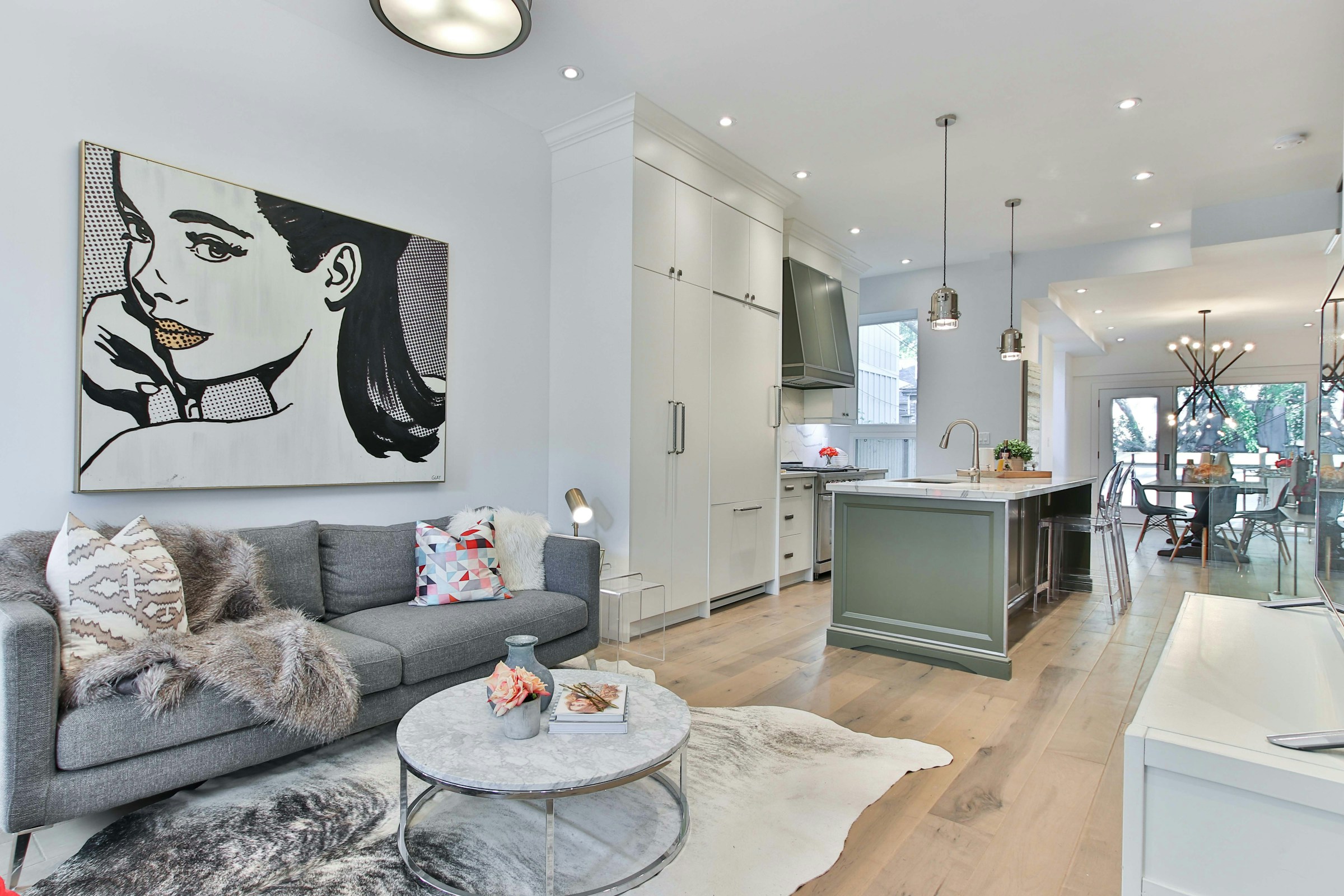
In practice this means that a single touch on a wall panel calls up the "Dinner" scene — the pendant above the table drops to 35 %, the floor lamps in the living area glow at a warm 2700 K, and the accent light on the painting switches off. The "Movie" scene lowers the blinds, kills the background light and leaves only a few points of orientation. Everything is programmed in a single logic, and the client can fine-tune every scene later through the mobile app or a voice assistant.
• DALI 2 / DALI Broadcast control of individual fittings and tunable white
• KNX scenes at room, floor and whole-house level
• Astronomical clock for outdoor lighting tied to sunrise and sunset
• Circadian curves for bedrooms and children's rooms
Climate and comfort
Climate is invisible until it fails — and then it becomes the only thing the residents notice. KNX lets us treat every room as its own climate zone with its own profile: the bedroom drops to 19 °C at night, the bathroom warms its floor to 26 °C by 6:45, the living room follows presence and window state.
We integrate heat pumps (Daikin, Mitsubishi, Vaillant), underfloor heating, fan coils, heat recovery units (Zehnder, Helios) and automatic shading into one logic. The pieces don't run in parallel — they run in coordination: if a hot day is forecast, the blinds drop before the sun hits the glass, and cooling doesn't fire on full but pre-conditions the space along a curve.
Multi-room audio
Music should follow the person, not the other way around. Our audio designs pair Sonos and Bluesound sources with passive ceiling speakers (Monitor Audio, KEF Ci, Bowers & Wilkins CCM) so the hardware disappears into the ceiling while the sound stays full-bodied.
KNX and Sonos talk to each other through a dedicated gateway: when you walk into the kitchen, the "Morning coffee" scene starts a Spotify Connect playlist at 22 % volume; when you open the terrace door the music follows outside; at 11 p.m. the zones drop to night level on their own. Audio is integrated with the door intercom — when the bell rings, every zone ducks, the visitor speaks, and then the music picks up exactly where it left off.
Networks and Wi-Fi
The network is the nervous system of a smart home — if it stumbles, nothing else works. That is why we build every project on the Ubiquiti UniFi platform: a carefully planned spatial layout of Wi-Fi 6 and Wi-Fi 7 access points, PoE switches in a quality rack cabinet, a perimeter-firewall gateway and a controller hosted locally (not in the cloud, for GDPR reasons).
Traffic is segmented through VLANs: the main family network, a guest network with time-limited access, an isolated network for IoT devices (TV, fridge, robot vacuum) which must not "see" private documents, and a dedicated network for KNX/IP traffic with its own QoS priority. The whole infrastructure is monitored 24/7 — if an AP drops, we know before the client does.
• UniFi Wi-Fi 6 / Wi-Fi 7 coverage with heat-map analysis
• VLAN segmentation with a dedicated IoT network
• Structured cabling in Cat6A to every meaningful position
• Fibre links between buildings on larger plots
Security
Security in a smart home is not just a siren — it becomes a layer that quietly interlocks with every other system. When you lock the front door in the evening, the house arms the perimeter zone on its own, dims interior lighting down to night-time guide paths and lowers the ground-floor blinds. If someone opens a basement window at 3 a.m., the "Intrusion" scene fires every outdoor light, unlocks the hidden siren and notifies the owner.
We work with Paradox and Satel alarm panels which speak to KNX over ASCII, with Hikvision and UniFi Protect cameras recorded locally (an NVR in the technical room — no footage sent abroad), and with access control via NFC card and code. Together this is a system that thinks rather than merely reacts.
Questions clients ask most often
For an average 100 m² apartment we plan 4–6 weeks from contract to programming, coordinated with the electrician and the contractor. For a 300 m² villa with outdoor areas and a pool the realistic timeline is 3–4 months, because it involves more scenario iterations and fine-tuning after move-in.
For a mid-sized apartment with lighting, climate and shading we start at around €12,000–€18,000 for the KNX scope, fittings excluded. Villas with audio, security and advanced scenarios typically run between €35,000 and €90,000. We always issue a fixed-price quotation after the concept stage — no surprises later.
We pass through the manufacturer warranties on hardware (typically 2–5 years depending on the brand) and we give a two-year warranty on our own work — programming, commissioning and network configuration. Every client moves onto a maintenance contract with an annual preventive check-up and a 24-hour SLA response.
The ideal moment is a new build or a major renovation, because the KNX bus needs its own cable next to every wall box. For existing properties we use a hybrid approach: KNX RF wireless switches, IP gateways into lighting and HVAC, and local KNX islands in the rooms where flooring is being lifted anyway. We always tailor the solution to what is realistic for you, not to what we would prefer.
Yes. We standardly deliver a Home Assistant bridge that exposes the KNX devices to Apple HomeKit, Google Home and Alexa, so you can mix them with other "smart" gadgets you already own. That said, every critical function (lighting, climate, security) stays on KNX and keeps working without internet — voice assistants are a convenient extra layer, not the backbone.
It is worth it as much as we plan the system together. For the transitional period we recommend a "core" module — KNX lighting and climate in the rooms you are not touching, plus structured cabling prepared for future zones. That way the 2028 renovation is no longer a fresh purchase, only an extension of the spine you already own.
Request an estimate — response within 24 hours
Send a floor plan or a few photos of the space. We come back with concrete next steps and a budget range, no strings attached.
Contact us